The standard model for yoga teacher training has not changed much in thirty years. You take three or four weeks off work, fly somewhere beautiful, practice twice a day for a month, and emerge with a certificate. It works. But it is built for a very specific kind of person — one who can disappear from their life for a month and afford to do it.
Most serious practitioners cannot. They have jobs, families, businesses, and responsibilities that do not pause for immersive training. The result is that many people who are genuinely called to teach yoga — who have a real practice, real experience, and something real to offer their future students — never complete a training. Not because they lack commitment. Because the format does not fit their life.
The hybrid model exists to solve that problem. But it does more than just make training accessible. Used well, it produces better-prepared teachers than the traditional residential format. Here is why.
The problem with the traditional 4-week intensive
A 28-day residential training packs an enormous amount of information into a very short time. Anatomy, philosophy, sequencing, adjustment, Sanskrit, history, business — all layered on top of twice-daily practice, often with inadequate sleep. Students frequently describe the final week as a blur. Many graduate with a certificate and a vague sense that they absorbed about sixty percent of what was taught.
This is not a criticism of residential trainings. It is a description of how learning works under conditions of saturation. The brain consolidates information during sleep and over time. There is a ceiling on how much can be meaningfully absorbed in a single sustained immersion, no matter how good the teachers or how strong the motivation.
“The best teachers I have trained are not the ones who came to the immersion knowing nothing. They are the ones who came having already sat with the material — who had questions, not just openness.”
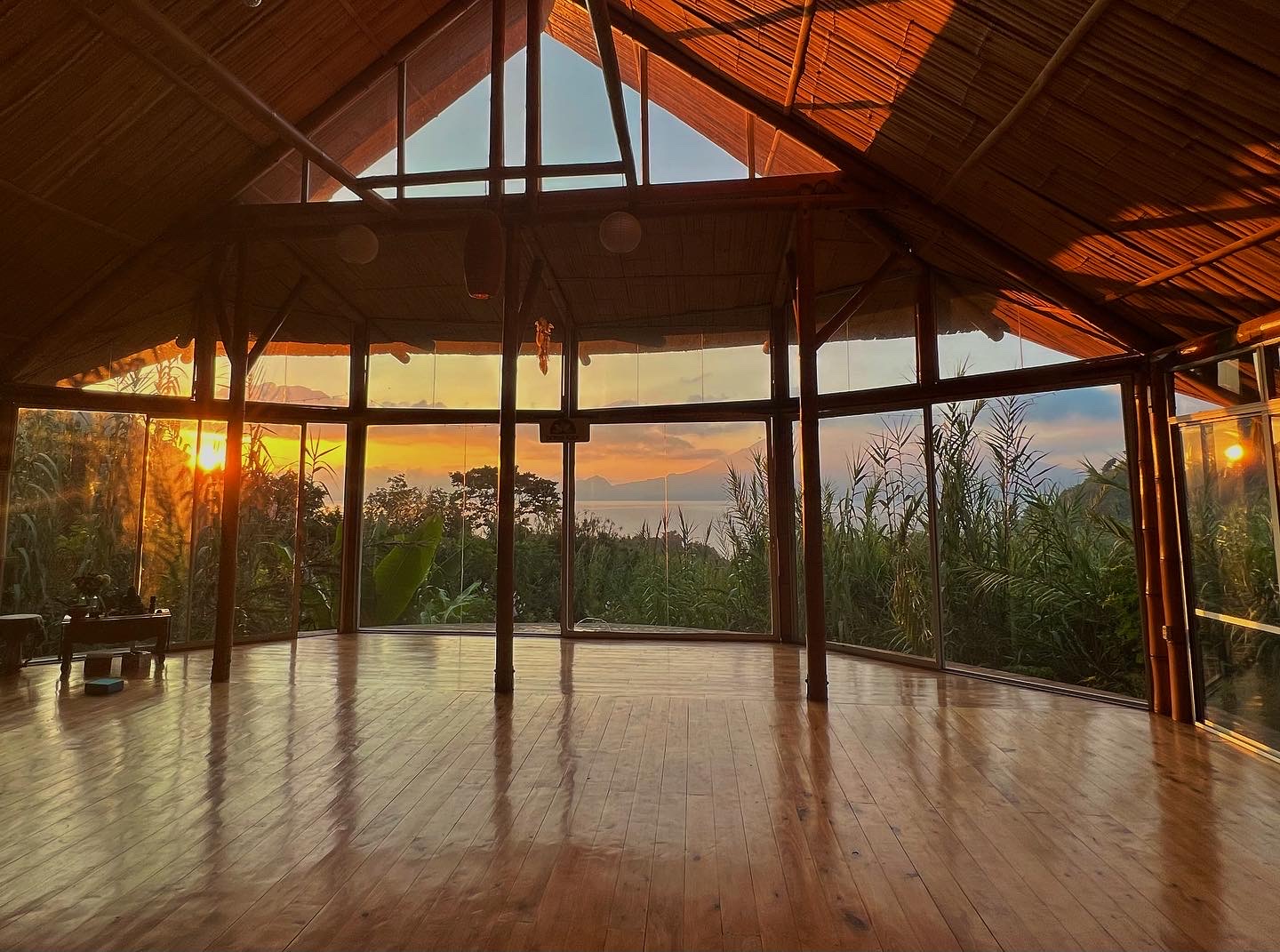
The Dharma Hall at Alma Atitlan — where the immersion takes place
What the online foundation actually does
In a hybrid program, students complete the theoretical and foundational material online before the immersion begins. Anatomy. Philosophy. The history of yoga. The principles of sequencing. Pranayama theory. The business of teaching. They work through this at their own pace, in their own time, while continuing to live their actual lives and maintain their practice.
This does several important things. It gives the material time to integrate. Students have weeks or months to sit with a concept, try it in their personal practice, encounter it in a class they are taking, and come back to it with new questions. By the time they arrive at the immersion, they are not starting from zero. They are arriving with a context that makes the in-person time exponentially more productive.
It also filters for commitment. Students who complete the online component and show up to the immersion have already demonstrated that they can sustain self-directed study. That quality — the ability to practice and learn independently, without external structure holding them accountable — is one of the most important qualities a teacher can have. The hybrid format selects for it.
Why the immersion still matters — and why location matters
None of this means the in-person component is optional. It is not. There are things that cannot be learned online: the subtlety of physical adjustment, the read of a room, the experience of being seen and corrected by a skilled teacher in real time. The embodied transmission of practice — what Zen calls dharma transmission — does not travel well through a screen.
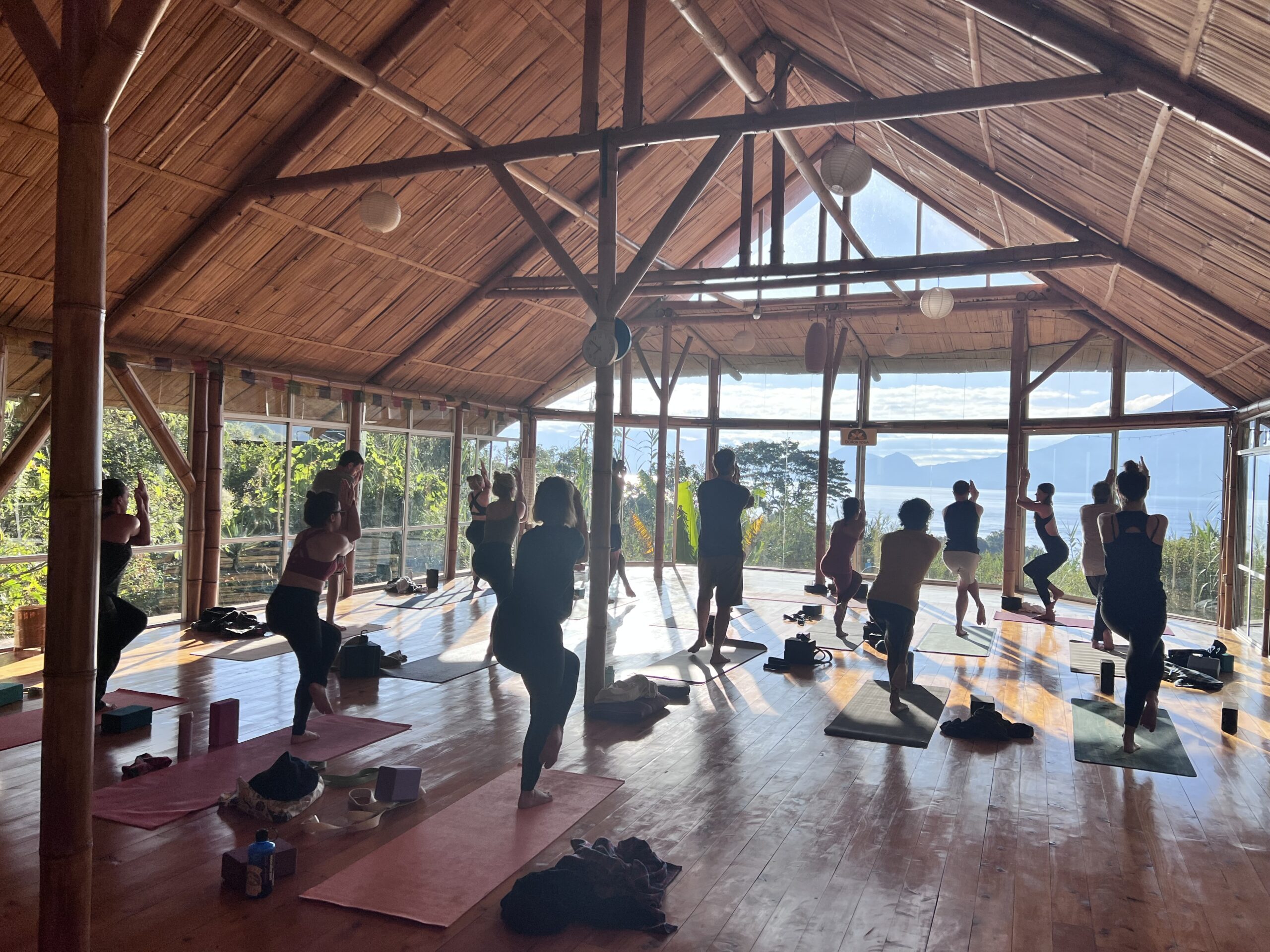
This is why the immersion at Lake Atitlan is eight days, not one. Eight days is long enough to go deep, short enough to sustain full attention throughout. The setting matters too. The Dharma Hall at Alma Atitlan — 180 square meters of cypress floor above the Tzununa river, with the lake and three volcanoes visible through full-length windows — is not a neutral container. The land itself is a teacher. Students consistently report that their practice shifts in ways that do not happen in an urban studio, regardless of how skilled the instruction.
Traditional 4-week residential
Who the hybrid model is right for
It is not ideal for someone who needs the external structure of a residential environment to stay motivated, or who has never maintained a self-directed practice. The online component requires genuine self-discipline. If that is something you are still developing, a traditional residential program may be a better fit — and that is worth knowing before you sign up.
A smaller cohort changes everything
Most residential teacher trainings run with 20 to 30 students, because the economics require it. The hybrid model at Alma Atitlan is built around smaller groups — intentionally. When a teacher knows each student’s practice, history, and specific areas of challenge, the quality of instruction changes fundamentally. Adjustments are accurate. Feedback is personal. The student who needs to work on their backbends gets different attention than the student who needs to work on their presence in front of a group.
This is not something that happens automatically with a smaller group. It requires a teacher who has been practicing long enough to see clearly and paying attention closely enough to use what they see. After thirty years of practice and training across multiple continents, that quality of attention is what Doron Hanoch brings to every training. The lake provides the rest.
The community that forms during the immersion is one of its lasting gifts
The honest argument
If you can take four weeks away, have the resources for a full residential program, and want the total immersion experience — do it. The traditional format has produced excellent teachers for decades and will continue to do so.
But if you are a serious practitioner with a real life, real commitments, and a genuine calling to teach — and you have been waiting for a format that fits — the hybrid model is not a compromise. It is a better design for how adults actually learn, delivered in one of the most extraordinary practice environments on earth.
The only question is whether you are ready to do the work.
The Doron Yoga Hybrid 200hr TTC
Online foundation at your own pace. 8-day residential immersion at Lake Atitlan, Guatemala. Smaller cohort, deeper attention, a setting that makes the practice real. Full details and enrollment at doronyoga.com.